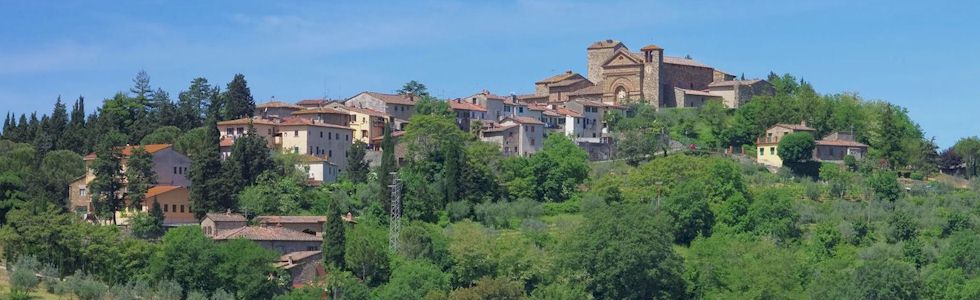
Panzano in Chianti is a charming Tuscan hilltop town located in the Chianti Classico wine zone of Tuscany. In fact, Panzano is situated exactly halfway between Florence and Sienna in the province of Florence, making it an ideal base for your vacation in Tuscany. Florence is readily accessible from Panzano in Chianti by comfortable bus (1 hour and 10 minutes) but a car is recommended for trips to Sienna because the bus route to Sienna is via Florence. The surrounding area is packed with interesting things to see and there are numerous restaurants in the area serving a wide variety of Tuscan specialities. Supermarkets and other food outlets in both Panzano and nearby Greve in Chianti, as well as the weekly outdoor markets in Panzano and Greve, make it extremely practical to cook meals at your own vacation accommodation. Because of its central location, day trips by car to almost any corner of Tuscany are possible from Panzano. Many vacation accommodations provide a pool and there is an excellent public swimming pool at Greve in Chianti.
The best months to visit Panzano are from May through September when the weather is sunny and warm. Because of its altitude and hill top exposure, Panzano is never really excessively hot even during August. The traditionally rainy months in Chianti are April and October, but even then showers and thunderstorms are usually brief. If it snows – and this used to happen often in winter but seems less frequent now – this will take place any time between late November and early March. Swimming pools are open during the warm months and air conditioning is rarely offered and rarely needed.
In short, depending on your interests, Panzano in Chianti is worth visiting at any time of year.
From Panzano, you can easily drive to any and all of the sights of Chianti including Greve in Chianti (10 minutes by car and also walkable), Montefioralle, Badia a Passignano, Gaiole in Chianti, Castellina in Chianti, Radda in Chianti and Volpaia. Check our map of Chianti for the numerous other sights in the area.
In addition, Panzano hosts a annual costume festival, the Festa della Stagion Buona on 25 April and an excellent wine festival, Vino al Vino, in September every year.
The beautiful Chianti countryside surrounding Panzano, including the wonderful Conca d’Oro, is dotted with classic Tuscan farmhouses offering inexpensive and attractive accommodation to tourists, the famous agriturismi of Tuscany. These can be Tuscan villas, entire farmhouses, country and village apartments or Bed and Breakfast rooms. Panzano itself has all you need for your holiday in terms of a supermarket, groceries and other supply shops, restaurants, an enoteca, a Sunday market and wine tasting opportunities, plus the famous luxury accommodations at Villa Le Barone and Vitigliano in the countryside nearby.
It’s usually a good idea to decide on the kind of location and what type of vacation accommodations you prefer before booking and certainly before visiting Panzano. In a similar vein, it’s recommendable to select a base and stick to it. Changing your accommodation every 3-4 days can wipe out a whole, valuable day with each change.
The types of holiday accommodation offered in and near Panzano include hotels, villa hotels, villas, farmhouses, apartments and rooms, including B&B rooms. There is sometimes confusion about what constitutes a “villa” in Italy, but, in brief, a true villa is a large structure with numerous rooms, while a family-sized, stand-alone house is basically going to be a farmhouse, a casa colonica. What type of accommodation you pick for your stay in Panzano basically hinges on how many of you there are, on whether you want a swimming pool and/or garden or not and on your budget.
Location, aside from the town you want to be near, is basically a choice between town or countryside. Your mode of transport will play a role in this decision, as will whether you plan to eat and spend your evenings where you are staying or to be out and about.
You can select a place to stay in Panzano using this website or, if you prefer, contact “Chianti and More“, our recommended local vacation rental agency.